
 |
| Wooden dummies of kung fu |
When most people hear the words wooden dummy, they immediately think of Wing Chun.
That is understandable. The famous wooden trunk with three arms and a leg has become one of the most recognizable symbols of Wing Chun, appearing in countless books, demonstrations and films.
But the wooden dummy does not belong exclusively to Wing Chun.
Chinese martial arts developed an extraordinary variety of training devices designed to provide resistance, improve accuracy, condition the body, develop footwork and allow techniques to be repeated without a training partner.
Some are little more than wooden posts.
Others have arms, legs, sandbags, springs, weights or rotating mechanisms.
Some move.
Some fight back.
And some look more like machines than what we normally imagine when we hear the words wooden dummy.
This article is an exploration of that largely forgotten world.
What Does “Wooden Dummy” Actually Mean?
The term commonly heard in Cantonese martial arts is Muk Yan Jong (木人樁).
木人 means “wooden person” or “wooden man,” while 樁 refers to a post, stake or similar fixed structure.
But applying the English expression wooden dummy to every Chinese martial training device can actually be misleading.
Not all of them imitate a complete human body.
Some represent arms.
Some provide striking surfaces.
Others swing, rotate or return force to the practitioner.
The important idea is not their appearance.
It is their function as repeatable physical training partners.
A human partner gets tired, moves unpredictably and can be injured. A training apparatus allows a practitioner to repeat the same movement hundreds or thousands of times against a consistent physical structure.
That makes it useful for developing attributes that cannot be developed by practicing movements in the air alone.
How Old Are Chinese Wooden Dummies?
Claims about the ancient origins of martial arts equipment should always be approached carefully.
There are references to wooden human figures in very early Chinese literature. Martial arts historian Benjamin Judkins has discussed a passage in Sima Qian's Records of the Grand Historian, compiled during the Han dynasty, describing a wooden human figure (ou ren) associated with fighting practice.
This is fascinating, but it does not demonstrate that the modern Wing Chun dummy—or any other modern kung fu dummy—descends directly from such ancient devices.
That would require evidence of continuous transmission that we simply do not possess.
What we can say safely is something more modest:
The idea of using artificial human-shaped objects for fighting practice is very old in China.
The sophisticated training devices found in modern Southern Chinese martial arts belong to a much later historical context.
Why Use a Wooden Dummy?
Different styles constructed different devices because they wanted to develop different attributes.
Depending on its design, a dummy can be used to train:
- distance and positioning
- angles of entry
- accuracy
- footwork
- body alignment
- striking mechanics
- limb conditioning
- coordination
- power transmission
- combinations
- recovery after contact
- weapon accuracy
A dummy is therefore better understood as a piece of specialized training equipment rather than an artificial opponent.
And nowhere is the diversity of this equipment more obvious than in Choy Lee Fut.
Choy Lee Fut (蔡李佛) probably possesses one of the most extensive collections of traditional training apparatus found in Chinese martial arts.
Historical accounts of the system describe numerous jong exercises, and Choy Lee Fut sources preserve a large curriculum of specialized dummy training.
Unlike the relatively standardized image most people associate with the Wing Chun dummy, Choy Lee Fut devices can differ dramatically from one another.
Some are designed primarily for conditioning.
Others develop timing.
Some force the practitioner to move.
Others use mechanical resistance.
It provides a surface for repeated striking with the fist, palm and other parts of the hand.
Its simplicity should not make us underestimate its usefulness.
Repeated contact with a stable target allows the practitioner to work on alignment, distance and the transfer of force into a physical object rather than merely punching empty air.
 |
| CLF wall bag |
Its construction allows the practitioner to work with the arms of the apparatus while developing striking, interception, positioning and coordination.
Traditional Choy Lee Fut descriptions emphasize strong power, accuracy and the ability to interact with resistance rather than merely memorize movements.
 |
| CLF ballanced dummy |
Once the bag begins swinging, distance is no longer constant.
The practitioner must adjust position, timing and striking distance according to the movement of the target.
This creates a fundamentally different training problem from striking a stationary object.
 |
| CLF sand bag dummy |
Instead of responding to one predictable moving target, the practitioner must remain aware of several objects moving through the training space.
It should not literally be considered equivalent to fighting three people, as my original version of this article suggested.
But it does create a more complicated environment for developing awareness, movement and timing.
Rather than simply absorbing strikes, the device creates a problem that must be negotiated..
 |
| CLF soi sau jong |
PALM BLOSSOM and SMALL PALM BLOSSOM WOODEN DUMMIES
 |
| Palm blossom wooden dummy |
 |
| small palm blossom wooden dummy |
 |
| Rice Bag dummy |
Here again, the important feature is geometry.
Multiple fixed points require the practitioner to change angle and position rather than repeatedly attacking a single target.
 |
| Knife tri star dummy |
 |
| Empty hand tri star dummy |
Instead of simply absorbing force, the apparatus stores energy when displaced and returns some of it.
The student therefore has to deal with a reactive object.
 |
| Spring Dummy |
 |
| Another example of CLF dummy |
The sheer variety found in Choy Lee Fut tells us something important. There was never one universal Chinese concept of what a wooden dummy was supposed to be. The apparatus was adapted to the training objective.
WING CHUN
If Choy Lee Fut has perhaps the most diverse dummy tradition, Wing Chun undoubtedly has the most famous individual design.
The Muk Yan Jong (木人樁) has become almost synonymous with Wing Chun.
Its familiar configuration consists of a central trunk, three arms and a lower leg.
Yet the history of the Wing Chun dummy is much less certain than popular stories suggest.
We do not have reliable evidence identifying a single person who originally introduced wooden-dummy practice into Wing Chun.
Stories connecting the dummy with the Southern Shaolin Temple or Red Boat opera performers belong primarily to Wing Chun's traditional narratives and should not automatically be treated as documented history.
The Planted Dummy
Earlier Southern Chinese striking dummies were commonly planted directly into the ground. Historical research into Guangdong martial training equipment describes posts secured in the earth while retaining some degree of movement or spring.
Wing Chun traditions also preserve this older configuration.
 |
| Dai Jong |
Yip Man and the Hong Kong Dummy
One of the most important developments occurred after Yip Man began teaching Wing Chun in Hong Kong.
Planting a large wooden post into the ground is practical when suitable outdoor space is available.
It is considerably less practical inside a Hong Kong building.
The solution associated with Yip Man's Hong Kong period suspended the dummy trunk between horizontal wooden slats attached to a supporting frame.
The result was compact enough for an urban environment while also allowing the trunk to move and rebound when force was applied. Wing Chun sources consistently associate this development with Yip Man's Hong Kong teaching period.
This is the version that eventually became famous around the world.
 |
| Yip Man training on wall mounted dummy |
Interestingly, what may initially have been a practical solution to limited space also changed the behavior of the training device.
The suspended dummy gives physical feedback.
Push it and it moves.
Release pressure and it returns.
That makes the mounting system itself part of the exercise.
What Does the Wing Chun Dummy Train?
A common mistake is to treat the wooden dummy as something that should simply be hit as hard as possible.
That misses much of its purpose.
The fixed arms create reference points around which the practitioner must position the body.
This allows repeated practice of:
angle, structure, stepping, distance, alignment and power transmission.
Wing Chun sources also emphasize the dummy's usefulness as a positioning and conditioning device while stressing that partner exercises such as Chi Sau and sparring remain necessary for developing genuine timing and sensitivity.
That last point is extremely important.
A wooden dummy cannot react like a human opponent.
Other Wing Chun Dummies
Wing Chun is not a single uniform tradition.
Different branches developed or preserved different training apparatus.
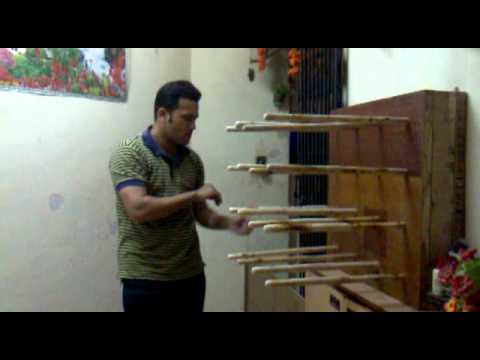
Some use bamboo constructions with flexible arms, sometimes described as Chi Sau dummies.
 |
| bamboo dummy |
 |
| Gerk Jong |
 |
| Vinetnamese Wing Chun dummy |
 |
| Cho Gar dummy |
One particularly interesting example is a device designed for practicing long-pole methods.
 |
| Long Pole dummy |
Some White Eyebrow or Bak Mei schools employ wooden training devices superficially similar to the Wing Chun dummy.
The configuration can differ, including variations with additional lower structures or legs.
 |
| Bai Mei wooden dummy |
Similarity of appearance, however, does not automatically prove direct historical transmission from one style to another. Different martial systems can develop similar equipment because they are trying to solve similar training problems.
Southern Praying Mantis / Chow Gar
Southern Praying Mantis traditions also preserve specialized dummy exercises.
Your original photographs show at least two substantially different configurations.
 |
| Chow gar wooden dummy. |
 |
| Another type of chow gar dummy |
Again, this diversity is more informative than trying to identify one design as the universal “Southern kung fu dummy.” There wasn't one.


White Crane presents an especially interesting case. The majority of White Crane traditions I have encountered do not make wooden-dummy practice a central part of their training. Some branches, however, use wooden training apparatus. Certain examples resemble the familiar three-arm Southern Chinese dummy, while others are quite different.
 |
| White Crane dummy |
Similarities between Wing Chun and Fujian White Crane have generated considerable discussion, and similar training equipment is sometimes presented as evidence of a connection.
But we need to be careful.
A similar wooden device by itself cannot establish historical descent.
We need lineage evidence, historical records, technical comparison and chronology before making such a conclusion.
The equipment is evidence worth examining.
It is not proof by itself.
 |
| White Crane dummy |
 |
| White Crane dummy |
Mok Gar (莫家) demonstrates the opposite extreme from the complicated mechanical devices of Choy Lee Fut. A training apparatus can be nothing more than a wooden post. Such posts can be used for striking, kicking, limb conditioning and developing appropriate distance.

Simple equipment is not necessarily primitive equipment.
If the training objective is simple, the tool can be simple too.


The five most common styles of southern Shaolin are Hung, Lau, Choi, Lee and Mok, named after the five great masters that taught in the south. Choi Mok Pai, takes its name from two of them, but it has also been influenced and contains elements from all these styles as well as a few others that the founder of the system had learned. There are two different kinds of wooden dummy in this system; they are just slightly different. The first wooden dummy of this system is pretty much the same shape and size as Wing Chun dummy but has only two upper hands.
 |
| Choi Mok Pai Wooden Dummy techniques |
 |
| Three arms dummy of choy mok pai |
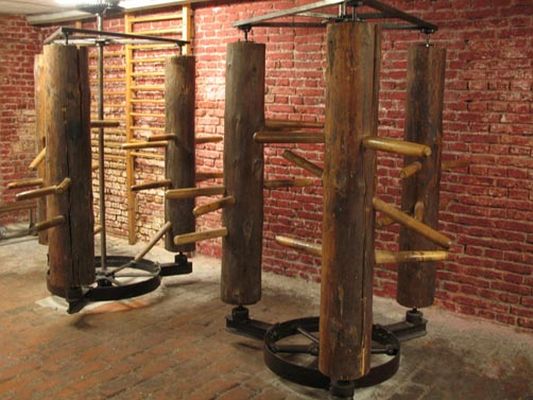
Hung Gar provides another large family of training apparatus.
Some examples are relatively simple.
Others become surprisingly elaborate mechanical constructions.

 |
| Plum blossom wooden dummy |
The variety reinforces the broader pattern we have already seen throughout Southern Chinese martial arts.
A jong is not one machine.
It is a training concept.

What Can a Wooden Dummy Actually Teach?
Looking at all these different devices reveals that the term wooden dummy training covers many different activities.
A solid post can condition the limbs.
A sandbag can develop striking accuracy.
A moving bag introduces timing and distance.
A spring-loaded device returns force.
Fixed wooden arms provide geometrical reference points.
Multiple posts force changes of angle and footwork.
A weapon dummy allows repeated practice against fixed targets.
Different machines create different physical problems.
And this is perhaps the most useful way to understand traditional martial-arts training equipment.
The design tells us something about what the people who created it considered important.
If a device moves, movement probably matters.
If it returns force, controlling force probably matters.
If it provides fixed angles, positioning probably matters.
If it contains multiple targets, transitions probably matter.
Traditional training equipment can therefore tell us something about the training philosophy of the martial art that produced it.
The Dummy Is Not an Opponent
There is also something a wooden dummy cannot teach.
It cannot think.
It cannot deceive you.
It cannot suddenly change strategy.
It cannot become frightened or angry.
It cannot hit you because you made a mistake.
Most importantly, it cannot reproduce the unpredictable timing and intent of another human being.
This is why dummy practice should never be confused with fighting practice.
The dummy is a tool.
A very useful one—but still a tool.
Its great advantage is consistency.
The same arm is always in the same place. The same target can be struck thousands of times. The practitioner can repeatedly examine distance, structure, alignment and movement.
Human partners provide unpredictability.
Training equipment provides repeatability.
A complete martial training method needs to understand the difference.
Preserving Traditional Training Equipment
When I originally wrote this article, my intention was simply to show the extraordinary variety of wooden dummies found in Chinese martial arts.
Over time, I have come to think there is another reason for documenting them.
Some are disappearing.
A traditional training device may survive only in one school or one lineage.
When that school disappears, the equipment can disappear with it.
Sometimes even the photographs disappear from the internet.
That is why I have deliberately retained many of the older photographs in this article, including some of relatively obscure training devices.
They may not be beautiful photographs.
Some are old and low resolution.
But they document something.
Preserving martial arts does not mean preserving only forms and techniques.
It also means preserving the tools, terminology, training methods and material culture surrounding those arts.
A wooden post standing in the corner of an old kung fu school may look insignificant.
But sometimes that piece of wood contains a piece of martial-arts history.
If you want to know more about wooden dummies in Chinese kung fu, you can check the book about that subject here ;