Friday, June 28, 2019

Wing Chun ,martial art or religion


Wing Chun, one of the most popular kung fu styles today is slowly becoming a religion. Many of the brunches and schools  have all cult characteristic since the beginning of Kung Fu craze in the late 1970’s. So what’s make a religion and what Wing Chun has in common with religion?  Here is a list of  characteristic common for most of the major religion systems today and we will compare that with Wing Chun.

1. Most religions include belief in the supernatural  or belief in some other Ultimate Reality beyond, yet connected to, human experience and existence. Vast majority of wing chun practitioners  believe that the art is some form of spiritual system, many believe and incorporate parts of other far eastern religions and make their own personal  believe system where kung fu practice cannot be distinguished from religious practice.A lot of them believe that Wing Chun is ultimate fighting system and in the end will grant them superior fighting powers. Some believe in supernatural energies and forces . Some are aware of this fact, most are not.

2. Religions distinguish between the sacred and profane (or ordinary) in terms of time, space, objects, and people. There are sacred days, objects and people in Wing Chun. Ancestors like Leung Jan , Leung Bik, Yip Man are worshipped as saints or gods are worshipped in other religions. These people are depicted as morally and ethically perfect and they had skills no one else ever achieved and could perform a miracles ( breaking a revolver with bare finger, fighting 300 life and death matches ect.). Artifacts left by those ancestors also hold a special place in Wing Chun community , anything that belonged to these people is highly respected and it is equal to sacred objects from formal religions. Sacred days are also established like Yip Man’s birthday, Wing Chun day ect. There are also places of pilgrimage like Yip Man’s tomb or his museum , Leun g Jan’s house ect.  

3. Religions strongly encourage or require prescribed ritual activities for individuals and communities of faith.  Most religions celebrate and reenact sacred stories through annual rituals, and Wing Chun is not an exception, annual ritual celebration are common and widely practiced. Also, personal rituals are practiced in the school or in individual practice. A lot of schools have altars and worshiping the ancestors is required before every class.

4.Religions commonly promote a moral code or ethical principles to guide individuals and communities. This is something that is happening in wing chun right now. The moral code is in the process of being established by practitioners. More and more moral messages in the form of supposed Yip Man’s quotes are surfacing every day . Although it is obvious that these moral messages have western origin , they are vastly accepted without any question and spread further among wing chun community.

5.Religious life engages and incorporates common emotional and intuitive human feelings.  These feelings include a sense of the wonder and mystery of existence, joy, guilt, and the bond experienced in the community. All these are common in Wing Chun and most of people practice the art because of these experiences. Many are not aware of this and they hold a belief that they practice martial art.

6. Religions both encourage communication and provide ways to communicate or connect with the divine. Wing Chun through its practice offers connection to the “divine” ancestors and their supernatural skills. Meditation is also common among wing chun practitioners and first form of the system is regarded as a tool of spiritual and supernatural forces and abilities cultivation.

7. Through sacred stories, the religions provide a coherent worldview. Creation myths (called histories) and stories about lives and achievements of famous ancestors are equal to creation stories and stories about saints from other religions. Creation myth gives a purpose of existence of the system and its practitioners while ancestor stories establish moral and ethical guidance system and also goals of practice (which can never be achieved).

8. Religions organize life for individuals--including dress codes, personal sacrifices, and appropriate occupations--in the context of their respective worldviews. In this area Wing Chun is still not developed enough, while the dress code do exist in most schools\organizations and everyday practice is a paramount of every practitioners life there are no restrictions or recommendations for occupation or serious persona sacrifice. On the other hand many practitioners do make sacrifices in a form of paying tuition fees which are often way over their real financial capabilities so they have to cut some other things from their lives in order to pursue Wing Chun lessons.

9. Religions require and promote social organization and institutional forms to carry out the necessary functions of worship and leadership, preserving orthodox teachings and practices. If anything Wing Chun surpasses any other religion on this point. Lineage is everything, we have cases that people with no martial skills what so ever are highly regarded in the Wing Chun community just because they are blood related to the founder of the style. People take pride to be connected and have “learned” from these figures because they believe that they are preserving the true, orthodox teaching of the founder if the art.

10. Religions promise an inner peace and harmony despite the vicissitudes of life. Wing Chun offers the same, it is advertised as an omnipotent system of practice that has answer to anything.
11.Most religions anticipate the coming of a gifted person  who will help usher in a new age of peace and tranquility. In this area Wing Chun is complete and accomplished religion because Wing Chun messiah already came in a form of Yip Man.

12.Religions must propagate themselves through the recruitment of new members and procreation within the community of faith. This point does not need to be elaborated , there is no other art that can compare with Wing Chun in matters of marketing and recruitment as well as talking bullshit about other martial styles.

Thursday, June 20, 2019

Wing Chun 1850's, Modern Wing Chun, Modern Boxing comparison

Wing Chun before 1860        Wing Chun, Leung Jan era- today         Modern boxing 1866 -today

Lowest  social class                    Highest Han Chinese social class       People from all classes 

Physically active, hard labor       Physically inactive, despise labor      Physically active, work or sport

In constant danger                       Never in danger, well protected         Some in danger, some not

Life or death fights regularly       Never need to fight on any bases       Sport fights,rarely self defense

Training for self defense             Training as a sign of social status       Training for sport or defense

Short, focused training                Long, detailed, theoretical training     Sport focused training 

Focus on effectiveness                Focus on technique's perfection          Focus on sport effectiveness 

Train to kill                                 Train for pleasure                                Train to put down the opponent

Train mostly with weapons         Train with weapons rarely                   No weapons

No forms or one form                  Multiple forms                                    No forms

Focus on sparring                        No sparring                                          Focus on sparring

Clear single goal in practice        No goals or multiple not clear goals   Clear single goal in practice

Rely on training& experience      Rely on myths and legends                 Rely on training & experience

System built on experience          System built on imagination               System built on experience

Hard body conditioning                No body conditioning                         Hard body conditioning

History& lineage not important   History & lineage very important        No history & lineage stories

Focus on present moment             Focus on the past                                Focus on present moment

Long fighting record                     No fighting record                               Long fighting record

Lost fight, lost life                        Lost fight, lost "face"                           Lost fight, nothing else

Tradition not important                Tradition most important                     Tradition not important

Technique simple and direct         Techniques complicated                      Techniques simple & direct


Friday, June 7, 2019

Going back to the roots


Has kung fu in general been taught wrongly for the past 150 years? Sadly, the answer is yes. There are several reasons why highly effective fighting styles became a joke in the world of modern martial arts.
For centuries Chinese people fought among them self and against foreign forces with more or less success, just like any other country on the world. For centuries, technology and fighting strategies and battlefield tactics changed and developed in a direction of more efficient fighting. Development of old fighting systems in China last until the end of Taiping rebellion where those systems were used on large scale for the last time. After the rebellion was crushed, and it was crushed with modern firearms and tropes trained by European and American officers to apply modern fighting tactics, even in close combat they were using bayonets as main weapon for close combat encounters. After Taiping rebellion was over kung fu started to decline and continued so until this day.

Before we discuss the reason for kung fu decline let’s see what does it looked like and how it was trained in the past. How kung fu looked like before Ming dynasty we have simply do not know. We have very rare sources without specifics, mostly just a mention of military fighting arts but without descriptions and details.  For the Ming dynasty period situation is not much better, how martial arts looked like during this period is largely unknown. On the other hand, for the first hand we have some martial manuals survived from this period. These manuals contain fighting techniques of various military weapons. From what we can see fighting techniques were simple, with simple, direct, no nonsense approach to fighting without complicated movements with sole goal to kill or injure opponent enough so cannot continue fighting. Empty hand combat did exist but was not used in military training and was considered completely useless on the battlefield, which is complete truth, and no one pay any attention to these techniques. Training during Ming dynasty was in some sense quite similar to modern military training. Officers had extensive education and fighting training while common tropes had short but efficient training. Common soldiers were retrained before every campaign, for example soldiers were trained extensively in using spears for 100 days. They trained to move and fight in infantry formations, single skills were not important for the outcome of the battle, only how efficient the unit is, although during 100 days period soldiers did train extensively in personal skills as well. Today basic infantry training last from 3 to 6 months for military conscripts.   Officers besides mathematics, astronomy, cartography, military strategy and tactics extensively trained with various weapons. There were several prominent schools for young officers during Ming dynasty where they learned usage of various weapons and archery. Martial schools in today’s sense didn’t exist, nor there were defined martial styles as we know them today. People determined their arts by the name of the teacher and teacher’s teacher. Martial schools were highly personalized and every student was taught to use his abilities to the maximum, which they needed on the battlefield, that is why styles in today’s sense didn’t exist. Fall of the Ming dynasty was caused by unfortunate set of events that ruined economy of the country and  last drop were weather condition that caused famine, people rebelled, administration fell apart and Mongols took over the power.

With the establishment of Ching dynasty not much was changed at first, at least not in a realm of military and fighting arts. Ching kept complete late Ming military formation and didn’t change anything  almost until the end of their rule. 

First significant change in martial arts came with the change of laws who can possess military grade weapons. By the end of the 18th and beginning of the 19th century some civilian structures were allowed to possess military grade weapons. Body guards, caravan escort, bounty hunters (known as marshals) were allowed to use long weapons. These occupations were usually family businesses and this led to development of different schools of fighting. We have to have in mind that China was much more wild than “wild west” ever was and these people were forced to use their skills on daily basis. Having efficient fighting technique was essential for these people and they again didn’t waste time on empty hand techniques because those were useless against swords, spears, maces and other weapons. People trained hard and didn’t pay  attention to unimportant things, most of the training was concentrated on developing strength, endurance, speed, reflexes, awareness, and simple but effective combat techniques, much like modern competitive martial sports but much more seriously because they lives depended on their skills. Also we have to have in mind that martial arts in China before 20th century were marginal activity. Less than one percent of people practiced martial arts in China during Ching dynasty period and this was the time when more people practice kung fu than ever before.

Taiping rebellion happened and showed at the end all the uselessness of old weapons and fighting systems against modern firearms. Swords and spears had no chance against modern guns. Ching dynasty rulers started to modernize their armies and kung fu became obsolete but unlike other parts of the world where fire arms simply erased traditional martial arts from existence, kung fu survived. After Taiping rebellion many things happened on social, economical, political and cultural level. Traditionally closed China started to open to foreign influences. There was a shift in usage and importance of kung fu, instead military fighting art it became social symbol of wealthy people. This is the time when kung fu as we know it today emerged in its recognizable form. First schools stared to open, and accent shifted from weapons fighting to empty hands fighting. Fighting efficacy was not the main focus of training any more. Instructors simply translated weapon fighting techniques into empty hands techniques without much thinking how and whether that will actually work. They started to invent more and more forms, drills and partner exercises in order to keep students interested and engaged as long as possible. Also, kung fu practitioners at end of the Ching dynasty were belonged to wealthy social class and didn’t actually have any need for fighting and that became obvious in their approach to training and we can see that today.

Ching dynasty finally fell in 1911 and new republican government used kung fu for socio-political project of busting national pride and promoted and supported spreading  kung fu to general population as much as they could. This is the time when, with a support of the government, all mystification and glorification of kung fu emerged. In the early 1920s kung fu was connected to classical Chinese philosophy, religion and “medicine” an in some cases with esoteric arts. For the first time kung fu was explained through classical Taoist theories and instead of fighting art was seen as a way of spiritualty, health and personal growth. While there is nothing wrong with all that and we are fortunate that kung fu outgrew its original purpose it is not fair to consider these systems of exercises as martial art styles, simply put  training does not prepare people for fighting and that became painfully obvious in modern time competitive martial environment. While there were still some people who practiced kung fu seriously and could fight that will soon change.
After civil war in China ended and communists came to power in 1949 first thing they did was to eliminate all those who could pose as a threat to new regime, among all others many kung fu masters were killed in that initial purge and their persecution continued for a long time. Same thing happened in Taiwan, Kuomintang went on a killing spree all over the island killing everyone who could even remotely be a threat to new established republic. Kung fu masters were first among many who were killed at that period. While in China kung fu was for a long time considered backward ,feudal practice and was actually forbidden for decades on Taiwan from the very beginning kung fu was and still is under firm government control. Neither side wanted people who know how to fight and especially teach others how to fight. In China modern Wushu was born as a replacement for traditional kung fu and in Taiwan kung fu, while kept all the content and information, was promoted and practiced as cultural heritage thing , not as a martial art.  Removed from its original purpose and environment kung fu developed in specific direction with no connection to real fighting.  It became burdened with overwhelming theories , unrealistic drills , enormous number of drills, visual impression became more important than anything else. On the other hand it is hard to find kung fu club that seriously work on developing all those traits necessary for real fighting. There is no real ,efficient fighting training like we can see in western boxing or kick boxing. People rely on qi and other mystical forces to develop fighting abilities but from experience we know that is never happen.
Sad truth is, kung fu people for the most part cannot fight, they lose time on training that is everything else but real fighting training. We have prominent teachers that not only never had a fight in their lives, but they are quite proud of that fact. Even more sad is the fact that kung fu in the past invented and used all the modern methods of training used in full contact sports today. For centuries kung fu people had much more serious training than any modern athlete, because no one will kill anyone in a boxing or MMA match but in Ching dynasty China people fought for their lives every day.

If we want kung fu to survive s martial art we have to do everything to regain its fighting relevance. This simply means we have to go back to old ways of training, just like people practiced during Ming and Ching dynasty era, concentrated on one goal only, ability to fight. Of course, I am not saying that kung fu should stop to be everything that it had become in the meantime, because for many people fighting is not important and they find in kung fu much more than just fighting , and that is a great thing. On the other hand if we call something martial art, it suppose to be that- a martial art , system of training that prepare people for fighting.


So how people practiced kung fu during Ching dynasty? First and foremost, people practiced kung fu to acquire necessary skills for the jobs they are doing whether they were body guards, caravan escort, bounty hunters, military, police... Kung Fu was a trade, essential part of their jobs, having sufficient skills ensured stable income. Kung fu was not practiced for fun, personal growth, spirituality reasons or anything like that. These people had to use their kung fu against other people who wanted to kill them. Training was extremely hard, but not as long as today. Instead of decades , people would practice for few years and then go to use those skills. Training was the most part concentrated on developing strength , speed, stamina, reflexes. Initial training was for the most part composed of long runs, staying in low stances for a long period of time, weight lifting ect. When practitioners were strong enough they would learn how to properly execute techniques and after they gain enough skill they would spend almost entire training in sparring. Usually, styles had one form or several short sets of movements but most often no forms at all. Forms are fairly modern invention. Sparring was usually done without protective gear and it was harsh and extremely painful but also very efficient. In old days it was more important to be able to hold a heavy shield and wave a saber or a spear for an hour than to perform technique beautifully and "correctly". Efficiency was put before everything else, simply they had to practice that way or they would be killed.

Of course I do not advocate this kind of training today, because most of the people do not want to be professional fighters or join military special forces but basic principles of the training and focus on the the right goals is what we can do. Instead doing things in a "traditional" way, btw. that tradition is less than 100 years old so it is not really tradition ,we can focus on achieving our goals through practical testing and developing  necessary skills and physical attributes. 

Saturday, June 1, 2019

True History of Qigong


Qigong is 5000 years old discipline that holds the secrets ancients knowledge about nature of the universe and has developed as practice of healing, maintain health, improving general quality of life and in some instances , enlightenment .This is widely spread believe despite the fact it is completely false.
The truth is that Qigong as we know it today didn’t exist before 1950. Not even a term qigong existed before this time.
Communist party of China led by Mao Zedong finished long civil war as a winner and immediately established a dictatorship. China , after more than a decade of constant war was ravaged, poor, underdeveloped and in complete institutional chaos. Just like any other communist regimes, Chinse communists simply eliminated everyone who can even remotely represent any kind of threat to the new established regime. Among persecuted were intellectuals from every field , medical doctor as well as everyone else. All those who did not manage to escape were killed or sent to prison to die there.  In an attempt to define its self as communist country , government declared that doctors ( in China called doctors of the “western” medicine) were followers of western capitalism and imperialism. This practice left China almost completely without medical care. To resolve this problem , communist government turned to the “traditional” methods of haling because these methods didn’t require any special education and all necessary things for such practice were available to anyone , especially there were no special requirements for pharmacology because traditional remedies were based in domestic  plant and animal life and minerals.
In 1954. Mao Zedong and the rest of the leaders of the communist party ordered development of ” Motherland medical heritage” (Zuguo yixue yichan 祖國醫學遺產)  with a purpose to get under centralize control absolutely all methods of healing  and maintaining health. Government started a campaign under the slogan “  Inherit and develop the medical heritage of the motherland” (jicheng yu fazhan zuguo yixue yichan 繼承與發展祖國醫學遺產)  and Mao himself stated that “Western medicine should learn from Chinese medicine “. This situation brought many “healers” and herbalists to the hospitals where they worked  as doctors (and were addressed as such) and even “research centers" were established.
With “motherland medical heritage” development  a lot of different old healing systems spread over China and were presented to the people as legitimate medical practice. Reevaluation of “traditional” medicine took place and was widely spread and used for propaganda purposes by the communist regime ,.Lu Zhijun 鲁之俊 (1911–99), Chief of Chinese traditional medicine academy (Zhongguo zhongyi kexueyuan 中國中醫科學院)  became famous  after he said  “China is the first country in history of human kind which performed medical  studies “ and “ China is the first country in history  which synthesized  drugs “  
As a result of this campaign  Taoists  practices were also incorporated in “traditional” medical practice .Person specifically responsible for bringing mostly Taoists and to some extent Buddhists practices under the umbrella of “motherland traditional medicine” was Liu Guizhen. He was high ranking communist official and according to his words in 1948 he got tuberculosis  and ulcer although there are no documents about his diagnosis and medical procedure to confirm his story.
After unsuccessful treatment in “western medicine hospital” he retreated to his home village to and there, from some unnamed old man he learned Neiyanggong ,traditional Taoist from  of cultivating Qi ,After only three months he completely healed and then shared his experience with local hospital .Local government , hearing about his case opened him an ordination in the local hospital where he treated patients and after short time he achieved astonishing results. This successes draw attention of the Medical officials of the Hebei province and in 1953, Neiyanggong   officially became part of the “motherland medical heritage” . Local officials helped Liu to open “laborer’s sanatorium”. In 1954 in the city of Tangshan first Qigong organization ever was established and the term Qigong used for the first time , coined by Liu. This place became crucial spot for acquiring new types of exercises and then spreading it all over China. Soon, patients from Beijing started to come and Liu had to go twice a year to bring a report to the minister of health.
Tangshan medical department started in late 1954 to organize seminars for doctors of the “western medicine” to introduce them with the practice of qigong as a part of the campaign mentioned before where western medicine should learn from Chinese ‘medicine” . Doctors who finished the course were obligated to spread  qigong through their everyday work. Liu organized additional three moths course in May 1955 where enormous number of medical doctors from all over China were obligated to participate and later had the obligation to spread everything they learned on that course.
Li wrote several papers on setting up a model of research and work in the field of traditional medicine that have become obligatory  literature for health professionals in China. In December 1955 Tangshan sanatorium was rewarded by the central government and at the organized award ceremony it was emphasized how important their work is in the domain of "homeland medical heritage". This was crucial and the last step in the general national recognition of Qi Gong.
From this moment on, the national institutionalization of Qi Gong  began as well as  publication of works from the domain of Qi Gong research .
Word Qigong was born in 1954 as a term that will unite all the different systems involved in the practice that we now know as Qi Gong. These systems include massage, stretching exercises and gymnastics, folk forms of physical therapy and treatment of bone fractures and joint dislocation, strength and  flexibility exercises from martial arts  and esoteric and meditative practice of Taoism and Buddhism. All these different practices that have nothing in common are included in time in a new formed health approach  and are  still considered to be part of the Qi Gong, which until 1954 were not. The term Qi is used in "western" medicine and actually means oxygen while in Taoist practice represents a primordial natural force. Before 1954, the term Qi Gong did not exist. In the martial arts, the term that was used is Lianqi(練气)  roughly can be translated as the refinement of Qi and represents biomechanical efficiency in the execution of martial arts. In Taoism, the term Yangqi ( ) was used, which literally means "to feed or raise" and signifies the practice of increasing and invoking primordial life force in order to prolong life, , enhance the functioning of the autonomic nervous system, increase the mental capacity of the brain, give greater mind control, increase perception and intuition, uplift moral standards, and give tranquility to the mind, which in turn confers inner harmony and greater happiness  and the end goal of this practice is achieving immortality . As time goes by, these exercises slowly open up the functional and control channels that feed and activate the energy, nervous and psychic centers, enabling the individual to have a deeper understanding, consciousness and awareness of the spiritual world get achieve immortality. These terms have a completely different meaning from the term Qi Gong. This term has enabled various methods of training acquired from different sides to be representative of medical practice, prevention, etc. With the emergence of the term Qi Gong, the term qigong therapy appeared, which is completely wrong and does not respond to reality, but is widely accepted today. (More confusion comes when eastern terms are used in western languages. Term Qi by its self has  many meanings which depend of the place of the word In the sentence and with what other word is used in conjunction. Qi as a single term means gas. People wrongly think that everywhere they see word qi used means some kind of primordial energy or whatever they believe, for example, old way to talk about the weather included the word Qi, but Qi of weather has totally different meaning from Qi in Qigong where first is just an expression for general weather conditions, same goes with Qi in Qi gong and Qi in Taoist practice but westerners believe that term Qi has same meaning all the time 
With the acceptance of the Taoist  methods of exercise there was a change in terminology and heavy revision of  history. All "obsolete" terms that resembled backward, feudal, primitive practices have been changed and replaced with new terms that sound "scientifically". The Communist government could not allow itself any connection with religion or esotericism. Also, under the Communist slogan that "the working people are the master of history" in order to raise the national pride, "history" of the Qi gong is located in the distant past where every trace of any physical exercise in order to maintain health is called Qi Gong, which is notorious nonsense. The effect of light gymnastics on health is known to all old civilizations, is not an exclusive discovery of ancient Chinese and has nothing to do with Qigong. Imitation of animal movement for the purpose of exercise is not qigong, but exercise and light gymnastics.
This process of collecting and putting anything and everything under the umbrella of Qi gong is still ongoing. Because of Qigong popularity many practices that have no connection to Taoism or Chinese medicine or medicine and health in general, in any way are called Qigong. For example, today there is something called Confucian qigong although Confucianism never had such practices and in some points is totally the opposite of Taoism. Other major thing pushed under Qigong umbrella is Buddhism. Various meditation practices are now called “Buddhist qigong”  although Buddhism never had nor practiced such things.
Of course, during the time, many "studies" were done in China proving the efficiency of the qigong. It is not a surprise  that those studies have shown such positive results, taking into account the policy of China at that time and Qigong and “traditional medicine” is are today billions worth businesses and give the employment large number of people . The best indicator of the efficiency of "traditional medicine" is the average lifespan of Chinese general population, which had until recently been one of the shortest in the world and at the level of the 19th century. Only with the increase of the   living standards and the ultimate establishment of the modern health system based on official medical science, the so-called Western medicine, the average lifespan of the Chinese people has increased and came close to countries with similar standards and healthcare.
Many confusions bring  alleged medical studies showing the efficacy of qigong. As qigong is  the general concept for a large number of different methods of exercise , different practice will show different results , but it must be clear what kind of practice was used , not just call it Qigong. Of course, light gymnastics will have positive effects on certain diseases, that is what physicians across the world recommend to patients since the establishment of modern medical science. Also massage is proven to be useful, just because someone puts the word "Qi-gong" in front of the word "massage" that does not mean that this massage really has anything with Taoist practice of force cultivation. On the other hand, there is no evidence that practices coming from Taoism have any positive effects on the prevention of disease or increase in length of life. Practitioners of these exercise systems have the same average lifespan and are suffering from  same diseases in the same percentage  as the general population.
As we can see, Qi Gong is a sociopolitical project of the Communist Party of China and has nothing to do with health. It is sad that a large number of people believe in the truly aggressive propaganda of the Chinese government and people who make profit by selling these “superior ancient knowledge”. The history of Qi Gong started less than 70 years ago , there are still a lot of people who remember times before Qigong. It is not thousands of years old and it isn't anything that its proponents claim it should be. 
How and why Qi Gong came on the "West" and gain popularity will be a subject of another article.


Thursday, May 9, 2019

Snake Crane Wing Chun - the oldest , original style of wing chun


Wing Chun history and art in general is a sensitive subject so I have issue a warning before start. Please , if you have problem with different opinions , if those opinions cause you mental pain and discomfort , if you believe that YOU and your style are entitled to some special respect and hold special place in Wing Chun community , do not, and I repeat ,do not read this article. You have been warned

There is everlasting debate which style is the oldest and more or most original. Everyone claims the same but not everyone can be right. Unfortunately there is no valid research on the subject to put those lineage wars at rest and debate will continue in the future.
Also , there are no clear criteria how do we determine the originality of the content and the age of the style. So before I start I want to establish at least some basic guide lines for determining the style’s originality and age.

1.       Direct historical evidence , which means artifacts and documents that can be verified
2.       Indirect historical evidence , mention in the sources of the particular time or having something ,like specific terminology ,rituals , heraldic that clearly suggest the time when those things have been used.
3.       Verifiable line of succession
4.       Establishing a single line of succession
5.       Technical content of the style

Talking about direct historical evidence, for now, the only style that presented verifiable documents form 1890’s is Snake Crane Wing Chun. These documents are examined by Foshan Wushu museum and to this day are the oldest Wing Chun documents in existence.  First documents that actually mention Leung Jan and his art are from the same time period but SCWC documents are several years older. While there are few claims form other styles that they have older documents and artifacts, these claims cannot be taken seriously because they are not available for examination because they are kept “secret” . If they are “secret” why even talking about it, if their existence is already announced why don’t let historians and archaeologists to examine them?  

Talking about indirect historical evidence, again, only Snake Crane Wing Chun has clear proof of late 19th century origin. First evidence is old Bai See ritual, unchanged from the time of secret societies from 19th century with blood sacrifice , witnesses , necessary props , spoken formulas ect. No other Wing Style has something  like that , not even remotely. Second evidence is Kuen Kuit. Kuen Kuit is a form of a poem that captures the essence of the art. Linguistically, only Snake Crane Kuen Kuit fits the late Ching dynasty era. All other kuen kuits of all other styles were written with modern Chinese language and fit era from the late republican period till today. (There was an attempt of kuen kuit forgery where SCWC kune kuit was used as a template but the forger’s knowledge of Chinese language was not sufficient and he used simplified Chinese characters which didn’t exist before 1954).

Snake Crane Wing Chun is also the only style that fulfill third and fourth point.  SCWC has clear , single line of succession back in the past till the middle of the 19th century. All ancestors existence can be verified , we have their photos , personal documents ,school records ,  indirect sources where third person mention their existence and involvement in certain historical events, we have their property , living witnesses ,grave sites. We don’t have that for any of the other Wing Chun ancestor , not for Leung Jan , nor  Fok Bo Cheun or Fung Siu Ching or even generation later like Leung Bik ect. We cannot verify existence of  Leung Bik or Fok Bo Cheun for example . And we do not know what martial arts they all practiced because non of their styles survived in its original form today. Someone may say Leung Jan’s side body style is his original art but that style changed so much in last 30 years to fit the demands of the market that we don’t even know how the art looked like in second half of 20st century, from white crane like style it transformed to Yip Man like style today. Again, Snake Crane is the only style today with a single line of succession, all other styles came from at least two or more different sources and those sources were not always Wing Chun but other arts like Tai Chi , White Crane,  Hung Gar, Choy Lee Fut ect.

Last , technical content of Snake Crane Wing Chun is quite unique and originally Wing Chun based. While every other style has its own unique and original content we cannot be sure it is 100% Wing Chun based. Many of the ancestors practiced some other kung fu style prior to Wing Chun, starting with Leung Jan , Chan Wah Shun and other Leung Jan’s students, Fung Siu Ching and others . Only Ancestors of Snake Crane Wing Chun practiced nothing but Wing Chun. I am not trying to say that other styles are somehow inferior in any way to SCWC , just stating well known facts. Only for SCWC we can be sure its content is completely Wing Chun based and it was the same , unchanged art from at least 1890 where the oldest verified evidence brings us.

Having this in mind , a lot of interesting questions are opening about true origin of Wing Chun and true significance of many "historical" figures .

Sunday, May 5, 2019

My teacher is a street fighter


More than often we can hear how some Kung Fu teacher has or had “street experience”, or was a famous “street fighter”. These claims are used as sort of proof of teacher’s fighting skills. Before we take this claims for granted and consider a “street” fighter a competent teacher let’s analyze what  being “street’  fighter actually means.
So who are “street”  fighters  and how do they gain “experience’. Adolescents  are more  likely to engage in a physical conflict  because of the nature of their developmental stage and psychological and social immaturity, of course his is not a rule and majority of young people do not want  have no desire and do not engage in acts of physical violence .For  average adult person fist fighting is probably the last thing in his mind. Yet , there are people who do engage physical violence on regular basis . We can distinct three different kind of street violence, “instrumental”,  “affective” violence and “bulling”. Instrumental violence is used as a means to an end – for example, in a robbery to obtain cash or goods. Affective violence is an end in itself, driven by emotion , as we see in cases of aggravated assault , bullying is a distinctive pattern of harming and humiliating others, specifically those who are in some way smaller, weaker, younger or in any way more vulnerable than the bully. Bullying is a deliberate and repeated attempt to cause harm to others of lesser power.
Research with high-risk, violent offenders indicates that low self-esteem, developed from a young age, can play a key role in triggering violent behavior. For example, a person may feel badly about themselves following a difficult, traumatic, abusive or neglectful childhood. Yet that individual may outwardly appear confident, even arrogant – scholars propose that this is a defense against inward feelings of shame, weakness, vulnerability and inadequacy. The theory goes that these feelings are so painful, that if the individual perceives that someone humiliates them or shows them disrespect, they are unable to tolerate it. A violent response restores a sense of self-worth and pride, while also punishing whoever caused that sense of injury or humiliation.

Bullies are made, not born, this behavior is typically fostered at a very young age. A difficult upbringing can result in low self esteem, which coupled with aggressive behavior can create a child who not only lacks communication skills, but feels the need to defend themselves constantly.
As we can see there is a lot of similarities between classical bully and dangerous violent attacker with poor impulse control. Actually young bullies usually advance to the stage of violent offender and these behavior is usually connected with criminal activities, although that is not always a case.
All three groups  are motivated to commit violence  as a mean of  gaining social status in their social circles and to satisfy their urges which they cannot control. Violet offenders   tend to anticipate feeling positive emotions after victimizing others. Such “happy victimizer emotions” are uniquely related to proactive aggression and as such may characterize attackers, who tend to initiate aggressive behavior as they focus on their own gains rather than the victim's feelings.These emotions come from the feeling of control and power over the victim.
All three groups will be very careful in selecting their victims. They will never attack anyone who may be endangered them in any way. Young, strong , fit , confident people are rarely victims of these attacks while smaller  obviously weak or sick people who show fear and insecurity are usual victims.
It is very rare to see “street” fighters fight each other , they know the other person is violent as much as they are and there is a great possibility of injury , also, they cannot gain anything on psychological level from the person who fights back.
As we can see , to become a ‘street” fighter person must have some psychological predispositions because normal , average people are not aggressive and they try to avoid violence .
So , there is a question to be asked , even if the claims of certain kung fu teacher and his “street” experience are true ( which are usually not) , is it wise to be associated with that kind of person? Other question is ,whether or not “street’ experience improve someone’s fighting skills? The answer is no , because there is nothing to be learned from fighting weaker , smaller people unable to defend them self. Only way to advance fighting skills is to fight against people with good fighting skills and competition fights re definitely the best way to do it. Teacher with good competition record will be much, much better than someone with “street” experience . 
Be careful when you choose your kung fu teacher , wrong decision  can affect your life in many ways .

Tuesday, April 16, 2019

Serbian warrior code


Medieval western European knights and Japanese Samurai from the same period are widely known and their codes of conduct became famous and highly praised in modern times.

The Code of Chivalry of medieval warriors dictated that a Knight should be brave and fearless in battle but would also exhibit cultured Knightly qualities showing themselves to be devout, loyal, courteous and generous. The qualities expected of a Medieval knight included bravery, courtesy, honor and gallantry toward women from which we get the image of the Knight In Shining Armor. The concept of a Code of Chivalry led to an idealized view of medieval knights in later times resulted in various legends knights and their adventures.
Bushido , probably the best known warrior’s code of conduct is basically a copy of European Code of Chivalry. Bushido was followed by Japan's samurai warriors and their precursors in feudal Japan, as well as much of central and east Asia. The principles of bushido emphasized honor, courage, frugality, skill in the martial arts, and loyalty to a warrior's master (daimyo) above all else

While history gave its final word on real medieval knights in Europe and Japan which is quite different from myths and legends,  there is a small country in Europe whose knights ,and not only knights but all warriors until today upheld the code of honor to the maximum possible level.  Serbian warriors had and still have the hardest code of conduct among all the warriors anywhere on the world. Also Serbian code of conduct was pretty much different from its western European or Japanese counterpart and there are several reasons for this.
First reason was socio- political system, Serbia never had slavery nor Feudalism. Slavery in ancient world played an important role in society and the economy, but Serbian people never had slaves and they would rather die than become one. While social hierarchy played important role in ancient Greece and Rome, among Serbian people such hierarchy was completely unknown, everyone were equal and there was no leaders. The only case when leaders were chosen was time of war , people would chose a war leader but immediately after the war he would return to everyday life and would not have any special privileges nor his social status would be  different from any other person . Unlike Feudal  western Europe where peasants were part of the property(land) and were basically slaves who could not marry or even travel without the special permission of their lord in Serbia peasants were free people . On the west feudal lord had complete control over the lives of the people on his land, Feudal lords were also part of the judicial system and it was there responsibility to uphold the law. In Serbia  nobility who owned most of the land was not a part of the judicial system which was independent and based in Roman Law, peasants were really protected by law and had the right to sue the landlord. Also, after 30 years of renting one piece of land peasants earned a form of pseudo-ownership, the landlord could expel  them form the property although the peasants could not sell the land which still belonged to the landlord.  Even if knight owned the land he had no real power over the peasants until the law was broken and even then law protected the peasants. The idea of freedom and equality among all people is in the very root of Serbian ( and other Slavic) culture.   Serbian people were free since the beginning of history and they value freedom above all else. That is the reason why Serbia never tried to occupy any foreign territory, all wars were defense wars without exception.


Second reason was religious. Majority of Serbian people were and still are devoted to Eastern Orthodox Christianity.  Unlike Roman Catholic church which was dominant political force in Europe for centuries and was more interested in political domination and economical domination by any means necessary including war, political persecutions, slaughter of heretics ect where millions of people became victims of the “Church” and the Monarch that Church controlled , Eastern Orthodox Church remained on the original path of Jesus Christ, being what Church suppose to be . Serbian Orthodox Church never had any direct influence nor connections to politics and if any influence was made it went to direction of peace. Serbian Orthodox Church was people’s church , it cared for its people and shared its destiny . Often, throughout history the church fathers along with priests and monks put them self in front of the incoming evil and took the first and hardest blow giving the common people time to find refuge for woman, children and elderly. Simply it cannot be found in Christian world (or any other religious realm) closer connection between Church and its people. In Serbia, Church represents much more than  just a religion it is a pillar of Serbian national being. There is no boundary between nationality and fate, being Serbian means being Orthodox Christian. Church was behind cultural and scientific progress for centuries. Its influence was and still is in every pore of the society and in every aspect of life but in very specific way. Church’s influence is,  much more spiritual in the past, equally moral, ethical, cultural and in dark ages that ravaged western world , kept and preserved classical Greek literature, science, medicine ,history ect which were taught to upper social classes. While western Europe swam in blood from religious persecution of the “heretics” where millions were slaughtered because their fate, witches were burned alive and books considered enemies and burned along with their owners, these things never happened in Serbia. No one believed in witches and books were not burned but kept and preserved as the rare treasure they were at the time. “Heresy” was forbidden by law but there was no death penalty for it. In fact in 13th century Serbian law was the most progressive and the most advanced law system in Europe based in Roman Law but improved and adjusted to the socio-political system in the country.  It is impossible to separate Serbian nation from its church, they are one and the same. This Church through the course of centuries , nurtured the moral and ethical code of Serbian people , that code in many ways improved original moral code from the Bible , making it more strict and more diverse in order to cover any possible situation. This code is the most strict but most emphatic moral code, the true representation of Christian values and believes. Christianity had such a deep roots in Serbian culture due to the fact that ancient Slavic people already had moral code identical to that form the New Testament based in love, understanding , compassion and acceptance.

Third reason is cultural. In Serbian society, the family and mutual support among members is highly valued. It is common to find several generations living under the same roof. Grandparents often help to look after their grandchildren while children look after their parents as they age. Many family members in the extended family try to remain in close contact with one another. Serbians will often view their cousins as siblings, in part because the Serbian language does not distinguish between cousins and siblings. Serbs have a special name for each direct and indiect ancestor 16 generations back, and for 5 future generations. Besides this, Serbs can easily determine relation to most cousins of the second and third generation simply by having particular name for uncles and aunts. Not only this, but their children are not called „cousins“ – they are brothers and sisters on uncle’s/aunt’s side. While in most countries the law allows marriage between 4th degree cousins in Serbia 4th degree cousins are considered close family , only in very special occasion Church will examine and maybe allow marriage between 7th degree cousins. There is the tendency among Serbians to stay in close proximity to their family in order to remain emotionally close. For example, children tend not to be encouraged to be independent or leave home. If they do move out, younger generations often live near their relatives. It is common for a Serbian family to host events or to frequently visit their family in order to maintain familial ties.
The typical household structure is patriarchal, with authority tending to come from the most senior male. Women are considered equal to men but are expected to honor their husband, on the other hand husband is expected to treat his wife as equal. In the past role of woman different from today but was still way better than anywhere else in the feudal world.  Age also gives authority in Serbian families and in society in general. The elderly are given utmost respect and are consulted when major decisions are made.
Giving the close bonds among relative Serbian build a strong bonds among friends and they are ready to help each other at any moment. This is clearly visible in small towns where people are closer and “old ways” are still the only ways. Especially in the time of tragedy literary the whole town will come to help and closest relatives and neighbors will take over everything on them self until the necessary things are finished ( like funeral ). Even people who hate each other will forget their dispute in the time of need and help as much as they can. Friends in Serbia have much closer relationships than closest relatives in most of the world.


The typically Western sense of individualism is not as prevalent in Serbia. They are often more family- and friend-minded. Individualism is most common in the time of danger such as war or some natural disaster when people sacrifice them self in order to save others.
“ Inat” is a peculiarly Serbian concept. Many nations will claim that it exists all over the world, but nowhere has the track record and evidence to back up the claim like Serbia. In short, it is the idea of doing something precisely because you have been told you can’t, the acting out of proud defiance in the face of insurmountable odds. It is record numbers turning up for a fun run in the streets of a city under aerial bombardment, or men and women holding BBQ parties on the roofs of that same town. It is being given the choice of changing religion or dying, and subsequently going for the latter.
The people of Serbia have never played nice with those in power, be they Ottoman leaders in the 17th century or international alliances in the 20th, or their own leaders. Serbs don’t like to be told what to do, especially by countries perceived as trying to police the world. Serbs have extremely strong sense of national pride and  they value the autonomy of the nation.
Hospitality plays important role in Serbian culture. Being invited to someone’s home for a meal is a great honor. Serbian family treats guests as royalty and they will serve only the best of everything they have. In the past hospitality played great social role because Serbs will cease all hostility towards person they shared food with. Even if the worst enemy seeks shelter and food he cannot be denied and he will be protected by all means necessary.
Honor is an extremely important principle in Serbia and is closely related to family values. One’s honor is connected with family reputation. Thus, preservation of honor is often understood in terms of the collective rather than the individual. In the event of an individual’s shortcoming, the whole family’s name and honor are often affected. There is also an expectation that family members will make necessary sacrifices for the common good. Family honor manifests in the loyalty that one has among family members. Betraying one’s kin brings a sense of dishonor and shame to the individual .Betrayal is one of the worst things individual can do in Serbia.

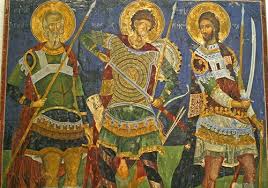
Based in Serbian culture and world view, code of honor of Serbian knight and the code of honor of the common soldier are the same. While in the West it was never expected from the common soldiers to follow any code of honor in Serbia that was natural thing. Knights and common people never differed as much as they did in the West in every way. Being a Knight in Serbia was the hardest possible thing , not only the warrior had to train rigorously with weapons but he also had to live his life as monk if he is not married and even if he was situation wouldn’t change much . Every Serbian knight also had to be educated in history with emphasis on every recorded battle of the past and military strategy, mathematic, reading maps, Greek language and sometimes poetry.
 But talking only about medieval knights wouldn’t be fair because same moral code guided Serbian warriors for centuries and it still in use today.
Serbia, like very few other countries on the world, never invaded other country, all wars were defensive wars. Serbia never fought against the enemy of the same size, we always fought unmeasurably stronger opponent. Serbia did loose wars but it was never defeated, never broken, never on its knees. Serbian warrior takes weapon in his hands for only one reason, to defend his children, to defend his family, woman and elderly, to defend his land which gives him life.  Never in its history Serbian warriors crossed the borders of other country in order to occupy, rule, to make colony, to have slaves, to rob natural resources and other valuable things. Serbian warrior can only fight the righteous fight, to defend what is sacred to him, his family and his land.
Serbian warrior is never afraid of death, not because he is insanely brave but because he is defending something much more valuable than his own life, he is defending his children, his family, his future. When you have you child behind no enemy can scare you, no force can break you, no evil can pass as long as you fight. In that fight there is simply no place for fear because if you are afraid everything you fight for will be ruined. Warrior may die ,battle may be lost, but his example will lead future generations on the path of final victory.
In Serbian culture death is not something to be feared, not in a way others fear death. Moment of death is a defining moment for Serbian warrior and the pinnacle of his life. The way Serbian warrior perceive death is described best in epic poetry. In epic poem, based on true events prior to WWI, old warrior, Krsta Radunovic sends his three sons to a battle against Turkish occupation forces and he is escorting them with these words :
“ There is no death , beside judgment day
Nor warrior’s glory without fighting
Those who die where they suppose to die
They built a monument for their lives “
All three sons died and old man, when he heard the news about his sons’ fate, with heart full of sorrow, said how proud he is and that he only regrets he couldn’t die with them together.
In other epic piece , the poet wrote these verses:
“ Everyone is born to die once
Honor and shame live forever”
Serbian warrior is afraid of dishonorable death, not death it’s self.
The way someone live and especially the way someone die is of outmost importance. Concepts of Honor and shame shaped the life of Serbian people from the beginning of time. Not only in war but in everyday life as well, keeping the honor intact is what life is all about. Life without honor is no life at all. There is no shame in losing the battle, no shame to be defeated by better or stronger opponent, if you die by fighting stronger opponent you gain eternal glory. On the other hand, lying, cheating, braking given word, is unforgettable and unforgivable. Loosing honor is worse than loosing life.
Someone’s life worth as much as his word. Saying things without consequences is completely alien to Serbian culture, once given, word cannot be broken, not even if that would mean certain death.
Warrior can lose only two things, face and honor. Neither of them can be bought, sold or owned separately from the person, either you have it or not. Those who die with honor stay alive in memory of the people and never truly die, same goes for those who lose honor.
Bravery and honor is so highly valued among Serbian people that there are countless examples of honoring fallen enemy who fought with honor, such enemy would get a funeral like any other Serbian hero. Captured in battle, brave enemy would be released with his weapons and would get respect like any other Serbian hero. Losing the battle or being captured does not mean losing honor. Serbian warrior is not a superman, he is just a man who fights for his freedom and his land and he is painfully aware that despite all efforts there will always be stronger, better, larger forces that cannot be overwhelmed.
Serbian warrior myth is more a real record of the events than an actual myth. While in other cultures knights do not have any flaws and they are undefeatable with often superhuman powers and magical weapons , Serbian knights on the other hand are so profoundly human, they have doubts, regrets, fears ,they make mistakes , yet they always manage to conquer fallen human nature and win the hardest battle of all, battle with them selfs. 
 Unlike western Europe there is nothing in Serbian ethos that will attack in any way strict warrior’s code. One of the key pieces of European literacy which is a corner stone of western civilization , Miguel de Cervantes’ “Don Quixote” was dedicated to only one thing, to ridicule high moral values of the knight , totally unfit for the modern world. This piece proclaims poor knight for a fool and down to earth servant on a donkey for an example of wisdom , promoting the victory of the practical mind. History showed consequences of this set of values. Western “enlightened” nations  occupied most of the planet killing hundreds  millions , making them into slaves, robbing their natural resources and destroying entire civilizations and their cultural heritage. In their madness they will give them self right to judge others, wildly attacking anything different proclaiming it dangerous.
It that Europe a small nation will still uphold traditional moral values , Serbian national anthem still begins with words “ Lord give justice to all…”  . Because of that , because of their faith, their moral values , their love for truth and justice Serbian people faced physical annihilation 3 times only in 20st century. In WWI country known as “dungeon of nations” along with germans and Bulgarians killed 30% of entire population, that was the largest genocide in the history of human kind. In WWII same enemies with support of Vatican killed over 2 million people, where 800 000 Serbs were killed in concentration camp Jasenovac in Croatia. First and only time in history of human kinds there was a concentration camp for children, Serbian children , opened with blessing of Vatican. In 1999 western countries under the umbrella of criminal , genocidal NATO alliance attacked Serbia and dropped so many uranium bombs that rate of cancer jumped 200 % . There isn’t a household in Serbia where someone didn’t die or is currently sick of cancer. This is the same pattern repeated so many times through history. Western “enlightened” nations first lead tremendous propaganda war convincing their people that Serbs are not human beings, that killing Serbian children is not a crime and then they send their soldiers to bring “culture” and these days “democracy”. Serbia was attacked for the same reason in the last 2000 years, we do not want to be like them, we have our own values ,our own faith, our own way of life, and we want to stay like that. West and East tried to change us, to break us, to make us more suitable for their global plans but we were never defeated and despite of all we still keep our heads high, we still live for justice and peace, we still pray in our own church.
 Despite everything that was done to Serbian people, there is no hate nor desire for revenge. Serbian people do not forget, ever, but Serbian people do forgive easily, giving anyone a second chance.
While fierce during fighting Serbian warrior would never do anything to dishonor his enemy, alive or dead. While many armies would rob prisoners of war often taking everything including cloths and same thing they did to fallen ones, Serbs never did such a thing. On the other hand, knowing with kind of people they fight, Serbs would always dress their best clothes and bring gold pieces that enemy could find something on their corpses, it was dishonorable if enemy would find a warrior in poor cloths and without money. Even in death, people cared about these things , no one wanted to be remembered as poor.
Mutilating corpses  was common thing , especially for middle eastern muslim armies although examples on the west are not rare. Such thing was  impossible in Serbia, enemy corpses if no one claimed them would be buried with military honors. Even more , there are examples where enemy soldiers were burred together with Serbian soldiers in the same tomb. After the battle on Cer and Kolubara where first WWI allied victory was won by small Serbian army that defeated more 10 times stronger opponent , several thousand Hungarian and Austrian soldiers found their final rest in the same tomb with their enemy. Serbian army honored all victims of that insane attack. While alive, Hungarian and Austria soldiers were enemies, but in death we are all equal in front of the Lord and we will all answer for our deeds. Dead soldier is no one’s enemy , just a lost souls that needs prayer for forgiveness of his sins.  
Prisoners of war were often treated better than regular army, simply , there is nothing that would make Serbian solider to do anything wrong to  person who cannot defend him self. Even in the last war , all NATO soldiers caught on the territory of Serbia were returned to their homes in much better condition than when they came.
Perfect example how Serbian warriors treated enemy, especially wounded ones can be found during Serbo-Bulgarian war in 1885. Bulgarian army, although well armed didn’t have any medical equipment , nor medical staff and many wounded soldiers suffered immensely. Being aware of the situation Serbia stopped the war for a day a allowed Red Cross train with medical supplies to go to Bulgaria. Although not well equipped its self ,Serbian army added four complete field hospitals to the Red Cross train composition. No army in history of human kind did such a thing for the enemy.
Other example happed in modern times, more precisely in 1993. During civil war in Bosnia all sides, Serbs, Croats and muslims were enemies. In summer 1993 overwhelmed by local muslims and “holy warriors, muslim terrorists from middle east Croats , stunned by the ferocity of muslims decided to search refuge from another enemy, Serbian army. Although extremely scared and fed with anti Serbian propaganda they realized that there is no other way. 15o Croat civilians and 450 members of Croatian rebel army seek help from Serbian army. Immediately Serbian army command refitted a school into refugee center and all necessary material was provided with children’s food and clothes that was found in an instant. Army command appealed to the civil population to help and in a matter of instant local people brought everything. Sick refugees were sent to the nearest hospitals. Wounded Serbian soldiers on their demand waited to receive help until several pregnant coratian woman finished the labor. All refugees , their condition, treatment and  medical procedures were recorded by Red Cross and on their demand sent mostly to Croatia and other places according to their desires . Two years later croatin so called army burned  a bus full of Serbian refugees , mostly woman and children.
About bravery of Serbian soldiers countless books were written. Serbian army never fought weaker opponent  and never fought on equal terms. Serbian army always fought stronger opponent and often fought the impossible odds and at the end always won.
In 1330 A.D. 15000 Serbs completely destroyed 80 000 bulgarian soldiers. Instead of concurring Bulgaria and robbing it , Serbian King saved Bulgaria from total annihilation , established a new king and preserved Bulgaria as independent country
In 1389. A.D. 12 000 Serbs met between 30 000 and 40 000 turks in the Kosovo field. Serbs won the battle but that victory was so expensive that country couldn’t recover biologically form the loss of man but Turks were stopped and didn’t manage to enter Serbia next 70 years.
In 1402. A.D. in the battle of Angora , Serbian army fought on Turkish side. Turks lost, Turkish ruler was captured and all prisoners executed, all but Serbs. Tamerlane was so impressed by skill, discipline and bravery of the Serbian army that he released the with complete weapons.
In 1806.A.D. 9000 Serbs with 5 cannons fought against 40 000 well equipped Turks on the field of Mishar. After fierce battle Turks escaped in Bosnia losing 6000 people. On Serbian side 500 people died.
In 1809. A.D. near city of Nis 16 -18000 Serbs fought 36-40 000 Turks. Overwhelmed by the number of enemies Serbian defense broke and Turks entered the Serbian camp. Fierce battle was fought all day. Seeing the impossible situation , Serbian commander Stevan Sindjelic took his pistol , entered the gunpowder magazine and fire his gun in th nearest barrel. The entire camp was destroyed leaving a the end of the day 4000  dead Serbs and 16 000 dead Turks. In order to punish Serbs , turks collected all heads of Serbian soldiers and made 4 meters tall tower made of those skulls.
November 1914 A.D. First major battle of WWI. Austro Hungarian army with 450 000 solders, well equipped entered Serbia in with plane to crush Serbian army in one decisive blow. On the other hand Serbian army had less 400 000  soldiers , poorly equipped and almost without artillery ammo. Loses on both sides were immense , Austo hungrian army had 30 000 dead, 173 000 wounded and 70 000 captured soldiers. Serbia had 22 000 dead, 91 000 wounded and 19 000 captured. Invading army was totally destroyed and this was first allied victory in WWI.


Orthodox Christmas 1915 , battle of Mojkovac. 20 000 Austrians with 45 cannons attacked 6500 Serbian soldiers from Montenegro who had 25 cannons. It is the bloodiest battle of WWI. Invading army was totally destroyed , Austrian field commander committed suicide after such a defeat.
1918 . Thessaloniky front., 62 000 Serbian soldiers literary destroyed 600 000 German , Austrian and Bulgarian soldiers. German emperor Kaiser Wilhelm sent a telegram to Bulgarian king Ferdinand :” 62 000 Serbian soldiers decided the outcome of the war! Such embarrassment!
In September 1941 Royalist and Communist resistance rose against Germans and in a few days liberated a large part of Serbia forming the biggest free territory in occupied Europe known as Uzice republic.
9. April- 10. June 1999 , battle for Koshare. 2000 Serbian soldiers and  few Russian  voluntaries fought against more than 6000 albanian terrorist , French foreign legion, Italian mercenaries with a support of NATO air forces and artillery. Serbian army lost 108 people died, 150 wounded and one light military vehicle  destroyed. Other side had more than 200 killed, around 350 wounded , 5 tanks destroyed,  2 A-10 thunderbolt II,   one  F-117а and one  F-16 . Despite hell of fire coming from the air and earth, Serbian soldiers did not retreat one foot never allowing terrorist to enter Serbia.


I will finish this article with few quotations from one of the most beloved rulers of Serbia , Lazar Hrebeljanovic . These vise words were said when he was informed about the size and strength of the Turkish army which was coming to occupy Serbia. Painfully aware that there are no chance for victory he still led his people to the battle, most important battle in Serbian history and while he lost his life he didn’t lost the battle and his words led Serbian people through centuries and gave them strength to do things others can only read in fantasy books.
“I do not decide whether or not I will go into battle by the strength of force that is threating me, but by the importance of holy things I am defending.”
“It is better that our grandchildren remember our deaths than our sons to forget us alive”
“I don’t put my head into the grave, I am putting into foundation of our future”